The Hub Agent Pattern: Turning AI Agent Assistant Sprawl into Enterprise Execution
Enterprise software is entering a new phase where the primary interface is no longer a dashboard. It is a conversation that can lead directly to action. Adobe, Microsoft 365, SAP, Snowflake, ServiceNow, and other major platforms are embedding generative AI into everyday workflows. The value proposition is practical. Business users can ask questions in natural language, receive answers grounded in enterprise context, and trigger actions that previously required multiple tickets, analysts, and handoffs.
This shift is also creating a new kind of fragmentation. Each platform is building its own embedded AI assistant with different tools, security boundaries, semantic assumptions, and memory. In isolation, each assistant looks powerful. In the enterprise, leaders end up with several intelligent experiences that do not naturally collaborate. The next advantage is not simply adopting AI within products. The advantage is orchestrating agents across the enterprise in a way that is consistent, governed, and measurable.
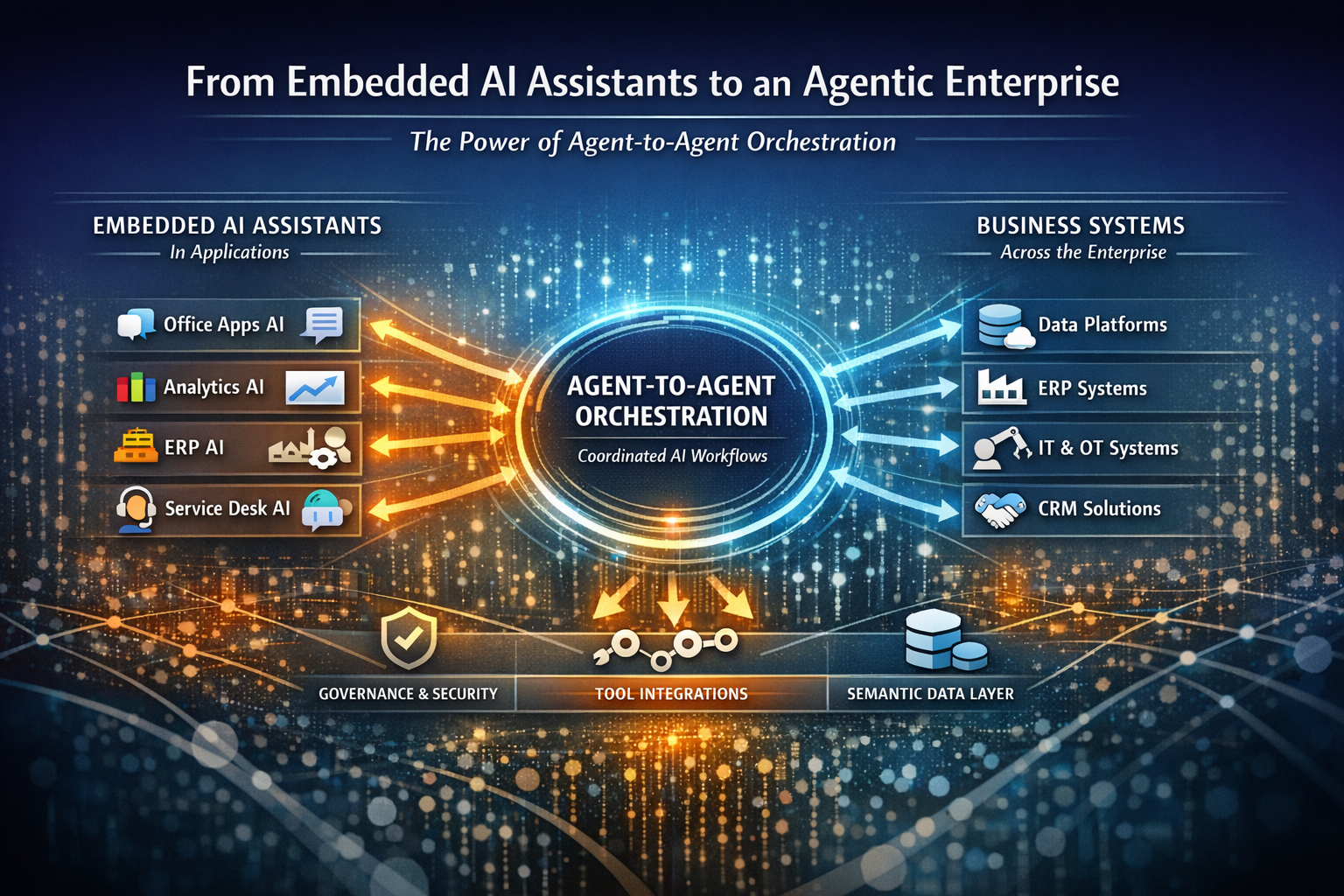
Agent to agent orchestration is the missing layer. It is the ability to route intent to the right agent, coordinate work across systems, and return outcomes with full traceability. It reframes AI from a scattered set of features into an enterprise capability that requires architecture, policy, and operational ownership. At scale, this becomes an AI control plane problem, spanning identity, authorization, policy enforcement, observability, evaluation, and audit logging across tools and agents.
The missing piece: a user facing hub agent
Most organizations will not succeed if users must choose which assistant to consult for each question. The enterprise needs a single conversational front door that lives where work already happens.
A practical pattern is a hub agent embedded in enterprise communication applications such as Teams and Outlook. This hub agent is primarily an experience and orchestration layer. It performs intent routing, context assembly, policy checks, and delegation to domain agents and application agents. The user experience becomes simple and consistent, even when multiple systems are involved behind the scenes.
In practice, the hub agent commonly operates in two modes:
- Answer mode where it analyzes, summarizes, explains, and drafts content using governed enterprise context
- Action mode where it invokes approved tools, triggers workflows, creates tickets, or writes back to systems of record, with safeguards
A concrete example is using Microsoft Copilot as the interface layer for employees inside Teams and Outlook. It can orchestrate across Microsoft applications and also coordinate with non-Microsoft agents, such as an analytics agent in SAP, Salesforce, Snowflake or a workflow agent in ServiceNow. Users interact with one hub. The enterprise retains control through explicit permissions, policies, and audit trails.
The AI agent ecosystem as an enterprise architecture stack
To make agentic AI sustainable, enterprises benefit from a model that mirrors familiar architectural stacks. Five layers define the emerging ecosystem.
- Embedded AI assistants inside applications: These live inside individual products and are strong within their own boundaries. They summarize, draft, search, and interpret. Increasingly, they can call tools to run queries, create workflow items, or update records. Their limitation is that they inherit the constraints of a single platform.
- The user facing hub agent: This is the front door in Teams, Outlook, portals, or other communication layers. It brokers intent, coordinates context, applies policy checks, and produces a unified response back to the user. It is where consistency of experience is won or lost.
- Agent platforms for building and governing agents: This is where agents become enterprise software. You define personas, tool permissions, guardrails, deployment channels, testing, monitoring, and lifecycle management. Without this layer, adoption tends to remain in pilots because every team builds agents differently.
- Tool and context connectivity: Agents need standardized, secure access to enterprise capabilities such as data sources, APIs, workflows, and documents. This becomes a tool gateway and control plane problem, requiring consistent patterns for authentication, authorization, input validation, logging, and rate limiting. Standardized tool schemas and context interfaces, whether via MCP or equivalent internal patterns, reduce brittle point integrations and make capabilities reusable.
- Inter agent coordination and orchestration: This layer covers routing, delegation, capability discovery, task decomposition, context sharing, approvals, and end to end audit trails. It is the difference between a helpful chat experience and an enterprise grade execution engine.
The key point is that enterprises are moving quickly toward conversational interfaces. They are moving more slowly toward the orchestration and control plane that makes those interfaces reliable, safe, and scalable.
What changes as AI becomes agentic inside applications
Across many enterprise suites and platforms, the technical direction is converging even when product names differ.
- From generation to execution: Embedded assistants are shifting from producing content to calling tools and performing actions. This is where value becomes measurable through cycle time reduction and fewer handoffs. It is also where risk rises because tool calls are privileged operations.
- From general assistants to multi agent specialization: Enterprises are creating domain agents with narrower scopes, such as finance close, supply chain risk, reliability, and IT operations. Specialization improves accuracy and governance, but it increases the need for orchestration across domains.
- From raw data access to semantic grounding: Strong implementations route analytics through semantic models, curated data products, and approved KPI definitions rather than raw tables. This improves repeatability and trust, and it makes auditability feasible.
- From single vendor workflows to cross vendor execution: Collaboration might happen in a productivity suite, analytics in a data platform, transactions in ERP, and work management in ITSM. Users do not care where the work happens. They care that it happens end to end, with the right controls.
Where most companies are today
Most organizations are operating in one of these patterns.
- Suite first adoption: Standardize within one ecosystem to move quickly. This is effective early, but integration debt builds when workflows cross platforms.
- Hub agent plus specialist agents: Use a single front door in Teams, Outlook, or a portal. Behind it, delegate to domain and application agents. This aligns best with executive expectations because it is outcome oriented.
- Orchestration fabric maturity: Mature organizations build a reusable orchestration layer where tools and agent capabilities are treated as enterprise services, with standardized access, centralized policy, and built in observability.
Why agent to agent orchestration is hard
The complexity is not the conversation. It is the enterprise control plane.
- Identity and policy enforcement across systems: Coordinated workflows must respect row level security, segregation of duties, approvals, and audit requirements across platforms.
- Tool sprawl and inconsistent action contracts: Every vendor exposes actions differently. Without standard contracts for invocation and outputs, orchestration becomes brittle and expensive to maintain.
- Governance must extend beyond chat logs: Enterprises need execution logs. That includes tool calls, datasets accessed, policies applied, write actions taken, and the rationale or confidence used.
- Security risks shift from wrong answers to wrong actions: When agents can update records or trigger workflows, prompt manipulation becomes an operational risk. High impact actions should require step up authentication or human approval, and all tool calls should be logged as execution events, not just chat transcripts.
- Reliability and evaluation are required for trust: Multi agent systems need timeouts, retries, fallbacks, monitoring, cost controls, and regression testing to prevent silent degradation.
A practical strategy: build an Agent Orchestration Fabric
A scalable strategy looks like building a new integration layer that connects people to systems through agents.
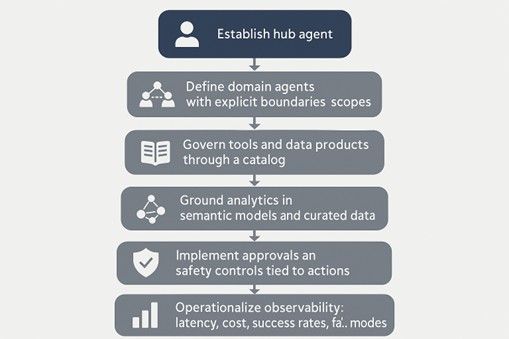
- Establish the hub agent as the front door: Put the enterprise agent experience where work already happens, such as Teams and Outlook. Make it the default interface so users do not need to navigate assistant sprawl.
- Define domain agents with clear boundaries: Build agents around outcomes and accountability. Finance close, supply chain risk, plant reliability, commercial insights, IT operations. Keep scopes narrow and tool permissions explicit.
- Create a governed catalog of tools and data products: Treat tools and workflows as first class assets that are versioned, approved, monitored, and scoped. This becomes the foundation for reuse and consistent governance.
- Ground analytics through semantic layers: Use curated data products and semantic definitions so answers are repeatable and reconcilable with enterprise reporting.
- Bake approvals and safety controls into execution: Separate read and write actions. Require policy driven approvals for high impact changes. Make audit trails easy to retrieve.
- Operationalize observability and evaluation: Track success rates, latency, cost, and failure modes. Maintain evaluation datasets for critical workflows and run regression tests when tools, prompts, or models change.
What good orchestration looks like in the real world
- Manufacturing reliability: A plant manager asks why a line tripped. The hub agent routes to a reliability agent that retrieves historian signals, checks ERP maintenance history, correlates conditions with known failure modes, and creates a prepopulated work order with evidence. The user receives a single summary and recommended actions. The enterprise gets traceability.
- Finance variance: A CFO asks what drove margin variance. The hub agent coordinates an analytics agent that queries governed semantic models and an ERP agent that reconciles posting context. The CFO receives a narrative aligned to approved definitions, plus suggested actions and owners.
- IT onboarding: A leader asks to onboard a new hire. The hub agent collects missing context, routes execution to the IT operations agent, triggers identity workflows, creates tickets where required, and routes approvals based on role risk. The user sees one conversation. The organization sees controlled automation with audit logs.
Executive takeaway
Organizations that treat AI agents as isolated features will modernize interfaces but keep the same operational friction underneath. The winners will standardize a user facing hub agent and build an orchestration fabric behind it that enforces policy, governs tools, and makes execution measurable. This is how conversational interfaces become execution engines, how automation scales safely, and how enterprises avoid a future where every application has an assistant but the business still cannot act as one.
About Author:
Towhidul Hoque is an executive leader in AI, data platforms, and digital transformation with 20 years of experience helping organizations build scalable, production-grade intelligent systems.